
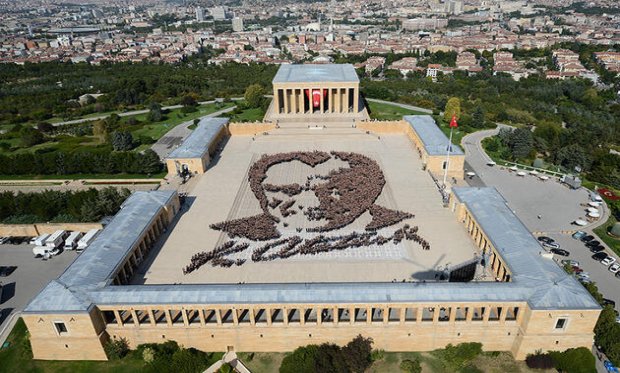
Anitkabir, the eternal resting place of Gazi Mustafa Kemal Ataturk, the founder of the Republic of Turkey, is one of Ankara's most important landmarks. Sculptures and reliefs depicting scenes from the War of Independence and the history of the Republic are displayed throughout the site.
Ataturk embraced the vision of the Turkish nation living under a democratic state. He achieved success by uniting with his people in the struggle for independence and national sovereignty.
On the 15th anniversary of the Republic of Turkey, Ataturk's health deteriorated, and he passed away on November 10, 1938, at Dolmabahce Palace.
During a conversation in 1923, Ataturk said: "I will certainly die one day; bury me in Cankaya and keep my memory alive." He then added: "My nation may bury me wherever it wishes, but the place where my memory will live on shall be Cankaya."
Anitkabir stands as an expression of the Turkish nation's infinite respect and gratitude toward him. It is one of the most beautiful and meaningful monuments of the Republic of Turkey.
Tombs belonging to the Phrygian civilization, which established a state in Anatolia in the 12th century BC, were found in this area. The former name of Anittepe is Rasattepe, which takes its name from an astronomical observation station that once stood here.
After the decision was made to build Anitkabir on Rasattepe, archaeological excavations were carried out to relocate these burial structures. The artifacts uncovered during excavations are now exhibited at the Museum of Anatolian Civilizations.
Anitkabir is a monumental structure that emphasizes symmetry and uses cut stone. It incorporates architectural ornamentation characteristic of the Seljuk and Ottoman periods. Its construction took 9 years, passed through 4 stages, and was completed in 1953. Its total weight is 150,000 tons.
One of the most striking sections of Anitkabir is the Lion Road, which visitors pass through before reaching Ataturk's resting place. This 262-meter-long road is lined with 24 lion statues on both sides, representing the 24 Oghuz tribes.
Sections such as the Mehmetcik Tower and the Museum Directorate feature stone decorations known as pinwheels and rosettes. These elements reflect the significant role of Seljuk and Ottoman art. The complex covers an area of approximately 750,000 square meters.
The mausoleum, inspired by Ataturk's famous words "Peace at Home, Peace in the World," consists of two main parts: the Peace Park and the Monument Block.
Phone: +90 850 307 0850
Web: ecocar.com.tr